
4 Steps to Planning a Successful Pyrolysis Project
To ensure your project is viable, and to give you a solid foundation when engaging suppliers or investors, it is essential to get to grips with the basics first. Here are the four critical steps to planning a successful pyrolysis project.
Project successes
Andrew
Pyrolysis and carbon removal through biochar is being recognised, no longer as an up-and-coming technology, but as an essential tool on our path to net-zero. As with any multi-faceted project, the process to go from concept to carbon can appear daunting with numerous moving parts.
To ensure your project is viable, and to give you a solid foundation when engaging suppliers or investors, it is essential to get to grips with the basics first. Here are the four critical steps to planning a successful pyrolysis project.
1. Secure Your Feedstock and Site
Before you start to think about pyrolysis technology, you must first focus on the "what" and the "where” - your feedstock and your site.
- Feedstock Analysis: Different materials produce different outcomes. You need to know exactly what your feedstock is, how much is consistently available, and its physical properties. Crucially, feedstock is often your largest operational cost. Understanding the maximum amount you are able to pay for raw material is vital for the long-term health and the financial viability of the project.
- Site Suitability: Your site needs more than just physical space. You must evaluate it based on permitting requirements and local regulations. Once you have a site and secured a feedstock supply, you can determine the scale of the plant you should be building.

2. Develop a Robust Revenue Plan
How will your project generate income? Pyrolysis is unique because it offers three distinct revenue streams. A successful plan balances all three:
Carbon Credits
The voluntary carbon market is a relatively secure income source, but eligibility is key. Different registries have specific nuances regarding feedstock traceability and lifecycle emissions. Ensure you qualify early so you can bank on this income.
Biochar Off-take
Biochar is a growing market with high demand in agriculture and industry. Ideally, you want an off-take plan that is local to minimize transportation costs and emissions. Having a clear destination for a significant portion of your biochar output is essential for financial stability.
Energy Recovery
While pyrolysis can be profitable without it, utilizing the excess heat makes the project significantly healthier.
- Heat: Using it yourself or co-locating with an organization that needs industrial heat can displace existing costs.
- Electricity: On larger sites, generating electricity provides a third layer of financial cushioning, for onsite use or if available, export to grid.
3. Build an Operational Model
By this stage, you should have a clear picture of your primary costs (feedstock) and your projected revenues (carbon credits, biochar, and energy). Now, you must pull these into a year-on-year financial model. Two key things to take into consideration are:
Debt Servicing: If you plan to borrow capital to fund your plant, your operational plan must prove that the project generates enough free cash flow to service that debt comfortably.
Contingency: A model that breaks if feedstock delivery is delayed or a machine part needs replacing provides risk. Always build in enough of a buffer to handle the interruptions of real-world operations.

4. Validation and Partner Engagement
The final step is validating your assumptions. At this point, you should know:
- The exact scale of your plant.
- Your daily feedstock throughput.
- Your projected financial outcomes.
Having these validated figures means you can move onto the next phase. Whether you are talking to equipment suppliers or financial partners, they will require this data to take your project seriously.
Moving from Planning to Reality
Planning a pyrolysis project is a complex journey, but you don't have to navigate it alone. Our consulting division has helped over 50 clients move through these early evaluation stages.
Get in touch with one of our Sustainability Consultants today to see how we can help turn your pyrolysis concept into a validated reality and a carbon removing plant.
Related insights
Onnu announced as Rainbow Partner
We’re pleased to announce that, following a vetting process and thorough assessment of our CarboFlow technology, Onnu has been approved as an official Rainbow Partner in the Industrial Biochar Tech Manufacturer category.
The importance of feedstock choice
The true foundation of your project's effectiveness and profitability is your feedstock. In this blog, we break down three of the most important considerations when it comes to feedstock planning: chemical properties, moisture levels, and supply chain security.
How we built CarboFlow’s intuitive HMI
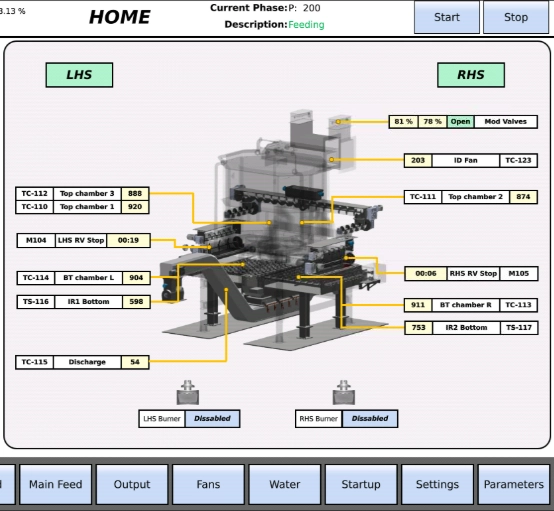
Modern pyrolysis machines are powerful and often very complex pieces of engineering. Whilst we understand our machines down to the last bolt, how do we make sure an operator understands the controls, flows and intricacies? This falls on the Human Machine Interface (HMI) which is, in very simple terms, a display screen used to control the machine.