
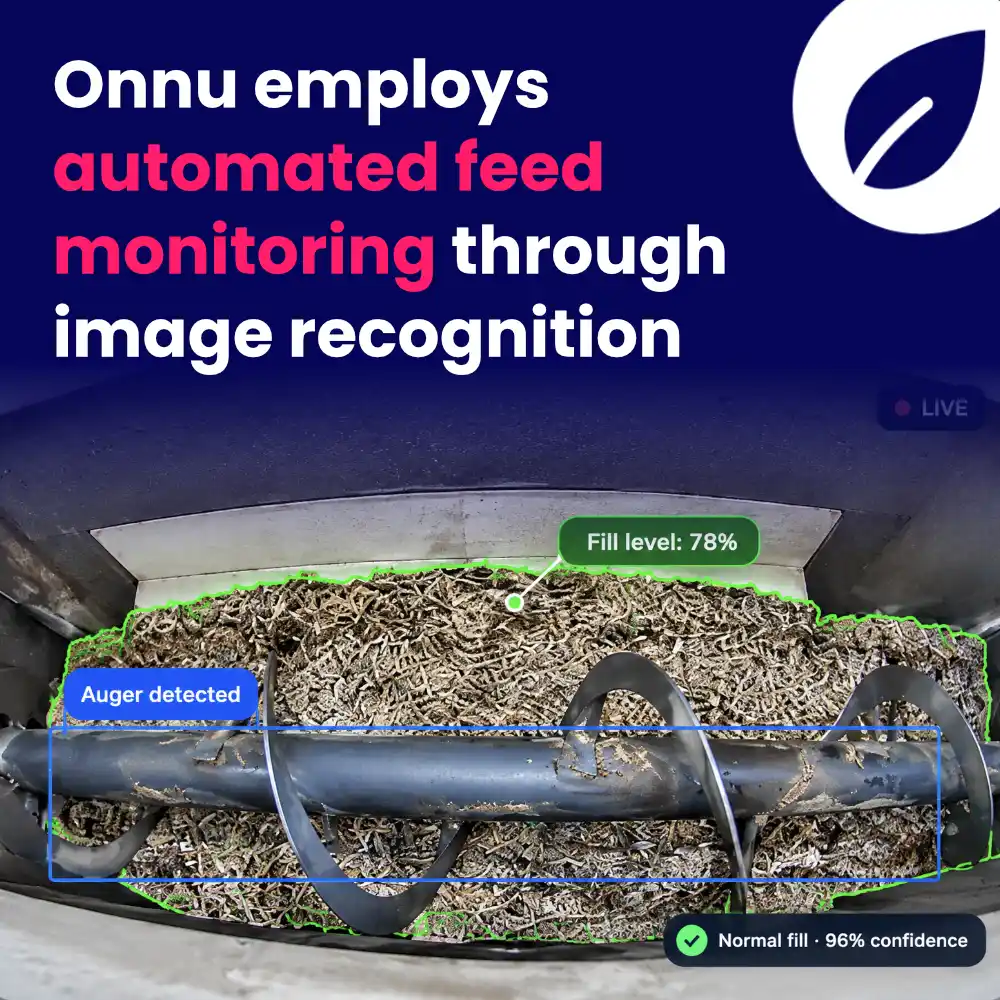
Onnu employs automated feed monitoring through image recognition
Onnu has recently partnered with AI implementation specialist for engineering firms, Mainspring AI, to add automated feed monitoring capabilities to its current and future CarboFlow installations.
Project successes
Andrew
Onnu has recently partnered with AI implementation specialist for engineering firms, Mainspring AI, to add automated feed monitoring capabilities to its current and future CarboFlow installations.
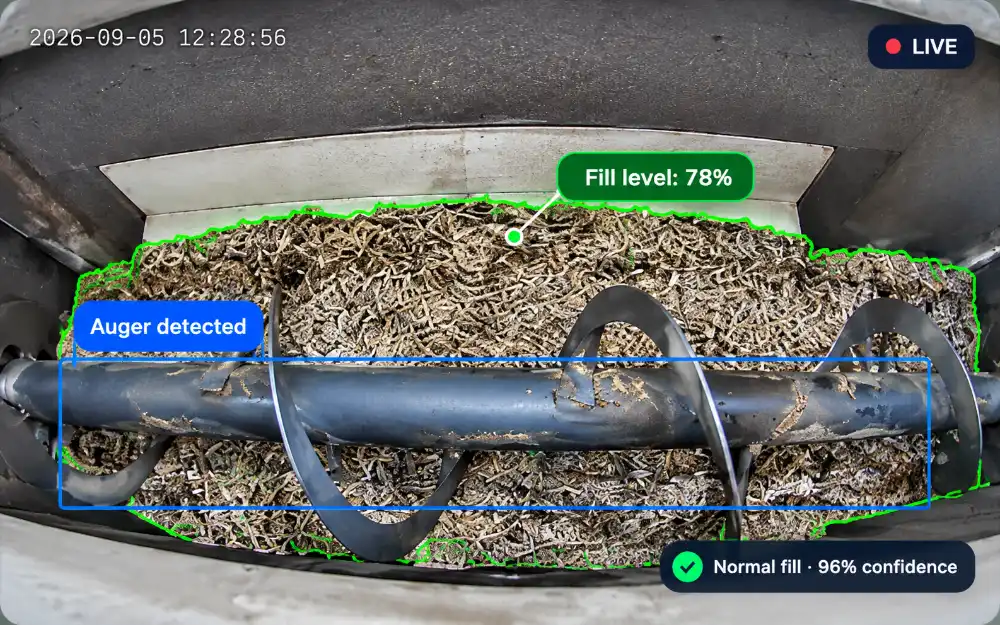
BioCarbon Technology Asia at Aumkar Plantation in Malaysia is the first site to have this new technology implemented, where it has taken over one of the most repetitive jobs on the plant floor - watching and monitoring the infeed. Cameras and a computer vision model now read how full each rotary valve is and adjust the feed automatically, freeing up to 40 operator hours every week.
Why the feed matters
Our CarboFlow plants run best when feedstock flows into it steadily, 24 hours a day. At the heart of that flow sit the rotary valves, which feed biomass into the system. Too little material underfills a valve; too much overfills it. Either way, the augers feeding it need their fill time corrected to run optimally.
When developing our CarboFlow pyrolysis machine, we first tried using level sensors to monitor infeed. However, these alone reacted too slowly to catch swings in fill level. The quick fix was a person. An operator watched live camera feeds above two valves and judged each one against six fill states every 90 seconds, nudging the auger timing by two seconds at a time. It worked, but it came at a cost:
• A full-time role tied to two screens. One operator was committed to monitoring, on a continuous line that never stops.
• Judgement that varies with fatigue. Making the same visual call every 90 seconds, across day and night shifts, invites inconsistency.
• Inaccurate recording of feedstock into the unit affecting data needed for carbon credit auditing.
• A brake on growth. Every additional valve or site would have needed more people watching more screens.
How it works
Mainspring built a computer vision model that does what the operator did, on every cycle, without tiring. It needed no new hardware, as the overhead camera already installed above each valve became the model's only input.
Quality was built in from the start. Every training image was annotated and checked by a person before the model learned from it. Each model version was then tested on images it had never seen, with accuracy reported for every fill state.
The results
After a successful trial run at BioCarbon Technology Asia, the system will now be fully deployed across both rotary valves across all sites using our CarboFlow pyrolysis technology. Manual visual monitoring has been replaced by real-time, automated classification that drives the augers directly.
Faster, more consistent corrections keep the line running smoothly, and operators can put their expertise into higher-value work. Just as importantly, monitoring is no longer the limiting factor on growth when considering future CarboFlow installs.
The end result is a plant that runs more smoothly, removes more carbon and frees its people to focus on what matters most. Good for the planet, the plant and the people running it.
You can read Mainspring's full case study ‘Automated Feed Monitoring through Image Recognition’ here.
Related insights
Onnu announced as Rainbow Partner
We’re pleased to announce that, following a vetting process and thorough assessment of our CarboFlow technology, Onnu has been approved as an official Rainbow Partner in the Industrial Biochar Tech Manufacturer category.
4 Steps to Planning a Successful Pyrolysis Project
To ensure your project is viable, and to give you a solid foundation when engaging suppliers or investors, it is essential to get to grips with the basics first. Here are the four critical steps to planning a successful pyrolysis project.
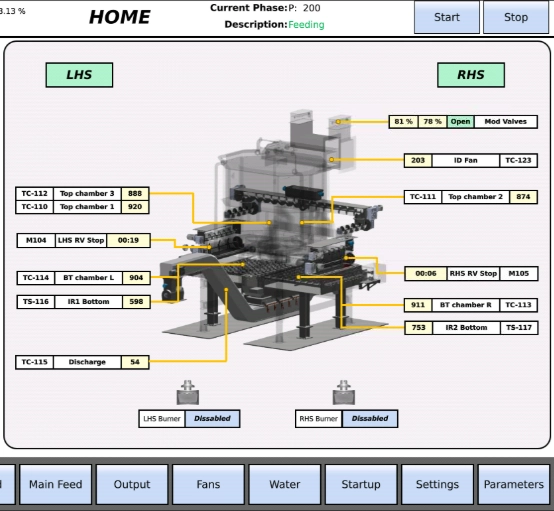
How we built CarboFlow’s intuitive HMI
Modern pyrolysis machines are powerful and often very complex pieces of engineering. Whilst we understand our machines down to the last bolt, how do we make sure an operator understands the controls, flows and intricacies? This falls on the Human Machine Interface (HMI) which is, in very simple terms, a display screen used to control the machine.